Fimo: The AI Website Builder Backed by 10 Years of CMS Expertise
2026-01-28 | ProductHunt | Official Site
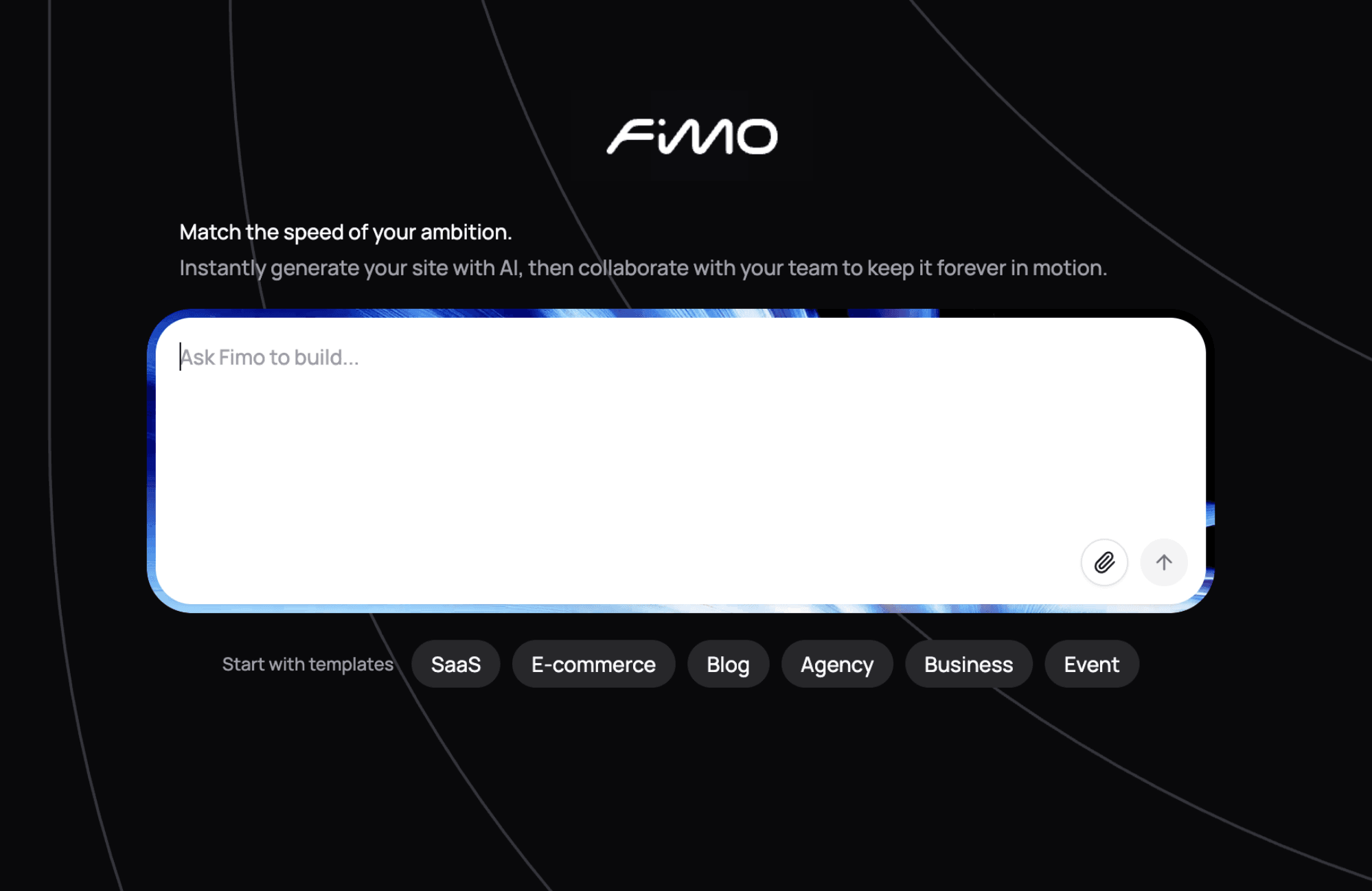
Screenshot Insight: Fimo's homepage is sleek and simple—a large input box saying "Ask Fimo to build..." followed by template buttons (SaaS, E-commerce, Blog, Agency, etc.). The dark mode aesthetic with blue gradients looks very modern. The core interaction is chat-based site building.
30-Second Quick Take
What is it?: A tool to create websites via AI conversation, focusing on "motion-first" design and built-in CMS content management.
Is it worth your time?: Yes. Here’s why:
- The team is from Strapi; they’ve spent 10 years mastering headless CMS and content management.
- While AI site builders are everywhere, most have weak CMS features. Fimo tackles this head-on.
- The free tier is enough to experiment with, and the learning curve is practically zero.
Three Questions: Is This for Me?
Does it matter to me?
Who is the target user?:
- Founders/small teams wanting to launch fast.
- Designers who find Webflow too complex.
- People needing robust content management (blogs, multi-page sites).
- Those who want high-end motion effects without writing code.
Is that me? Fimo is relevant if:
- You want to prototype a website with AI in minutes.
- You’re building a SaaS or tool and need a Landing Page + Blog.
- You don't have a dedicated frontend dev but need to update content frequently.
When to skip:
- You already have a mature workflow (e.g., Next.js + Vercel).
- You need complex e-commerce features (carts, payments).
- You require pixel-perfect control over every single CSS property.
Is it useful?
| Dimension | Benefit | Cost |
|---|---|---|
| Time | First draft in 5 minutes | Learning prompting techniques |
| Money | Free tier is capable; $25/mo for unlimited projects | Pricier than Framer (starts at $10) |
| Effort | Conversational UI, no complex tools | Need to refine AI-generated results |
ROI Judgment: If you find Webflow too daunting or Framer's CMS lacking, spend 30 minutes on Fimo. The 3-project free limit is plenty for evaluation.
What's the "Wow" Factor?
The Highlights:
- Instant Launch: Deploy to fimo.site with one click—no config needed.
- Smooth Collaboration: Includes a staging environment; preview changes before going live.
- Native CMS: No need to set up external CMS configurations like in Webflow.
The "Aha!" Moment:
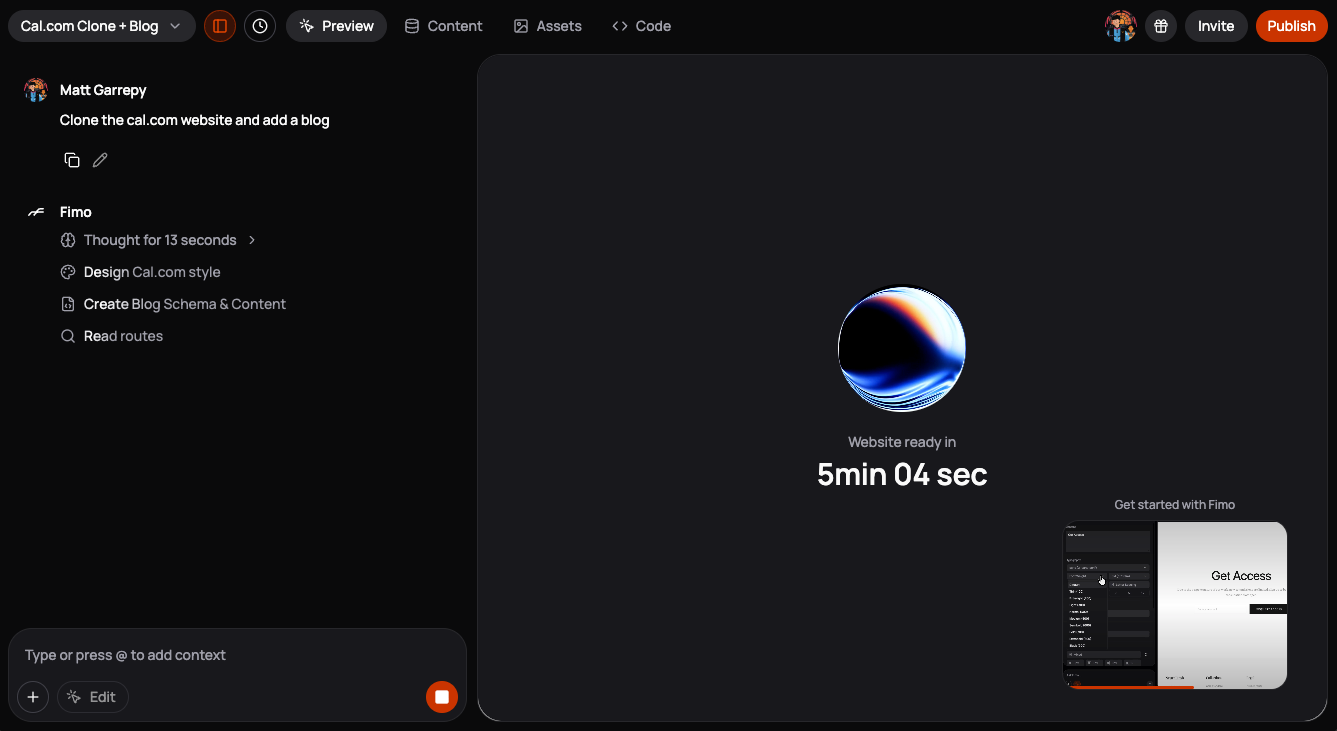
Screenshot Insight: On the left is the chat area with a prompt: "Clone the cal.com website and add a blog." The AI thinks for 13 seconds and starts executing: Design Cal.com style → Create Blog Schema & Content → Read routes. The right side shows "Website ready in 5min 04sec." Essentially—you tell it what you want, and it figures out how to build it.
What users are saying:
"We've put a lot of work and love into it to combine the best of AI website builders and CMS" — @Jean-Sébastien Herbaux (ProductHunt)
"It's early days (um, day one, actually), so running a workload is still something I need to assess" — CMS Critic
To be fair, since Fimo just launched, external feedback is still limited. ProductHunt comments are mostly from the team and early supporters.
For Indie Hackers
Tech Stack
| Layer | Technology |
|---|---|
| Architecture | AI-native CMS, integrating Strapi philosophies |
| Hosting | Built-in global CDN, one-click deployment |
| AI Model | Undisclosed (likely using major LLMs) |
| Extensibility | GitHub integration and code export on the roadmap |
How it Works
Fimo's strategy is to merge Strapi's headless CMS expertise with AI generation. You describe requirements via prompts, and the AI generates the page structure, content, and styles. Once generated, you manage content in a CMS interface just like a traditional backend.
Compared to other AI builders, Fimo's differentiator is its content management depth—unsurprising given the team's 10-year pedigree.
Open Source Status
- Strapi: Open-source, 60k+ GitHub stars.
- Fimo: Closed-source commercial product.
- Code Export: GitHub integration is on the roadmap, which will allow code to reside in your own repository.
Business Model
- Subscription: Free / $25/mo.
- Credit Consumption: Each AI prompt costs credits; the free version gives 2,500/mo.
- Strategy: Free tier for user acquisition → Premium for conversion.
Giant Risk
It's there. Figma has launched an AI Website Builder, and Webflow and Framer are aggressively adding AI features. Fimo's survival depends on:
- Leveraging the team's deep CMS expertise.
- Doubling down on the "Motion-first" niche.
- Staying focused on websites rather than general-purpose "vibe coding."
For Product Managers
Solving Pain Points
"Building a website used to take months. Starting today you can create one in 10 seconds."
Core pain points: Slow development cycles, dependency on technical staff, and cumbersome content updates.
How painful is it?: Moderate. For teams with ample dev resources, this isn't a huge deal. But for solo founders, small teams, and non-technical staff, it's a major bottleneck.
User Personas
- Early-stage Founders: Need a Landing Page fast to validate ideas.
- Content Creators: Bloggers and Newsletter authors needing a personal hub.
- Small Agencies: Rapidly prototyping site concepts for clients.
- Non-technical PMs/Ops: Wanting to update the site without bothering developers.
Feature Breakdown
| Feature | Type | Description |
|---|---|---|
| AI Conversational Builder | Core | Prompt → Website |
| Built-in CMS | Core | Content management, multi-language, SEO |
| One-click Deployment | Core | Global CDN |
| Collaboration/Staging | Nice-to-have | Team preview before going live |
| Template Library | Nice-to-have | SaaS, Blog, Agency, etc. |
Competitive Landscape
| Dimension | Fimo | Webflow | Framer |
|---|---|---|---|
| Learning Curve | Very Low | Steep | Moderate |
| CMS | Strong (Built-in) | Strong (Needs config) | Weaker |
| AI Capability | Core | Auxiliary | Integrated |
| Motion | Motion-first | Standard | Strong |
| Price | $0-25/mo | $14-39/mo | $10-25/mo |
| Best For | Fast build + CMS | Complex design + SEO | Portfolios + Landings |
For Tech Bloggers
Founder Story
Pierre Burgy — Co-founder & CEO of Strapi
- Background: Master's in Web Design (HETIC), BBA from EGC Business School.
- 2015: While a student freelancer, he got fed up with WordPress's lack of an API and built his own tool.
- Mindset: "Because we were students, we weren't even used to having a salary, so we were comfortable having very little money and we were so bullish on the project."
- 2017: Went full-time, rewrote Strapi v3, and saw a massive user surge after posting on Reddit.
- Success: Strapi raised $47M, hit 60k GitHub stars, and 12M downloads, becoming the most popular open-source headless CMS.
- Investors: Nat Friedman (former GitHub CEO), Index Ventures, CRV, Accel.
Fimo = FOREVER IN MOTION — A clever name representing a site that is always "moving"—through animations, dynamic content, and continuous iteration.
Points of Contention
- Closed Source Shift: Strapi is open-source, but Fimo is a commercial closed-source product. The open-source community might have thoughts on this.
- Crowded Market: With Figma, Webflow, and Framer all doing AI, can Fimo carve out a unique space?
- Credit Model: Will users feel restricted by "counting credits," or will the experience remain fluid?
Hype Data
- ProductHunt: #7 Weekly Top, 426 votes.
- LinkedIn: Kima Ventures (under Index) celebrated the launch post by Pierre.
- Twitter: Discussions are just starting to pick up.
- CMS Critic: "It feels fresh, even if it's entering a noisy segment."
For Early Adopters
Pricing Analysis
| Tier | Price | Features | Is it enough? |
|---|---|---|---|
| Free | $0 | 3 projects, 2500 credits/mo, fimo.site domain | Great for testing, tight for production |
| Premium | $25/mo | Unlimited projects, 25000 credits/mo, Custom domain, 30-day history | Necessary for serious use |
Hidden Cost: Credit consumption. Every prompt uses credits; frequent tweaking can deplete your monthly allowance quickly.
Quick Start Guide
Setup Time: 5 minutes.
Learning Curve: Very low. CMS Critic notes "even a novice will find it comfortable."
Steps:
- Sign up with GitHub (recommended) or email.
- Pick a template or enter a prompt.
- Wait for AI generation (usually a few minutes).
- Tweak in the editor.
- Click Publish to go live.
Tips:
- Check official docs for prompting tips to save credits.
- Starting from a template is more credit-efficient than starting from scratch.
Pitfalls & Complaints
- Credit Management: CMS Critic suggests using prompts "judiciously and strategically."
- Early Stage: It's brand new; expect bugs and unknown long-term stability.
- AI Genericism: AI might produce generic designs that require manual polishing.
- Free Badge: The free version includes a Fimo badge; you'll need to pay to remove it.
For Investors
Market Analysis
AI Website Builder Market:
- 2023: $3.17B
- 2026 Projection: $6.3B
- 2033 Projection: $31.5B
- CAGR: 25.8%
Drivers:
- 81% of developers report productivity gains using AI tools.
- No-Code market projected at $38.5B by 2032.
- The rise of the "Vibe coding" trend.
Competitive Landscape
| Tier | Players | Positioning |
|---|---|---|
| Leaders | Webflow, Wix, Squarespace | Mature platforms, full-featured |
| Designer Tools | Framer, Figma | Design-to-site workflow |
| AI-native | Fimo, Lovable, Durable | AI-first approach |
Fimo's spot: A new AI-native entrant with a unique edge in CMS capabilities.
Timing Analysis
Why now?:
- AI generation is mature (GPT-4 level LLMs are ubiquitous).
- "Vibe coding" is a popular concept with high user acceptance.
- The Strapi team provides 10 years of CMS credibility.
Risks:
- Tech giants (Figma, Adobe, Google) are all entering the space.
- The market is crowded; rapid moat-building is essential.
Conclusion
The Bottom Line: An AI site builder from the Strapi team with powerful CMS roots. It's just launched, so it's worth watching closely.
| User Type | Recommendation |
|---|---|
| Developers | Wait and see. Tech stack is opaque; code export isn't live yet. |
| Product Managers | Worth following. The CMS+AI approach is a great case study. |
| Bloggers | Great story. "Strapi team's second act" is a strong angle. |
| Early Adopters | Try it out. The free tier is perfect for evaluation, but don't migrate yet. |
| Investors | Watch the team. Strong Strapi background, but a very competitive sector. |
Resource Links
| Resource | Link |
|---|---|
| Official Site | https://fimo.ai/ |
| Documentation | https://docs.fimo.ai/ |
| ProductHunt | https://www.producthunt.com/products/fimo-2 |
| CMS Critic Review | https://cmscritic.com/vibe-coding-fomo-fimoai-offers-easy-website-building-with-ai-native-cms-capabilities |
| Neon Blog Feature | https://neon.com/blog/meet-fimo-ai-the-ai-native-cms-from-strapi |
| Pierre LinkedIn | https://www.linkedin.com/in/pierre-burgy-strapi-88671673/ |
2026-01-28 | Trend-Tracker v7.3